Summary:
As Bangkok prepares for the 2026 debut of the Lumpini Hawker Center, the city is embarking on a structural transformation of its informal economy. By migrating traditional street vendors into a regulated, digitally-integrated hub, Bangkok is not merely clearing its sidewalks; it is building a blueprint for how megacities can scale micro-entrepreneurship through 21st-century infrastructure.
Excerpt:
The transition from the chaotic charm of Bangkok’s alleyways to the organized efficiency of the Lumpini Hawker Center represents a strategic shift in urban architecture. This project serves as a "digital bridge," connecting the raw authenticity of local culinary specialists with the high-utility requirements of a modern global metropolis, ensuring that the city’s smallest economic units remain competitive in an increasingly automated world.
The Architecture of the Informal Economy
For decades, Bangkok’s street food has functioned as the city’s most resilient economic engine. It is a sector characterized by extreme fragmentation and high human mobility: a decentralized network of specialists who have mastered a single dish through years of repetition. However, as the city’s "gravitational pull" as a global business and tourism nexus increases, the traditional, 20th-century model of informal street commerce has begun to clash with the demands of modern urban planning.
The current move toward the Lumpini Hawker Center is not merely a relocation of stalls; it is a strategic institutionalization of the informal sector. By adopting the "Singapore Model": a structured approach to street food that emphasizes hygiene, logistics, and central management: Bangkok is attempting to solve the tension between cultural preservation and urban efficiency. This shift represents a move toward "Scaling the Small," where the micro-vendor is no longer an outlier in the city's master plan but a core component of its value chain.
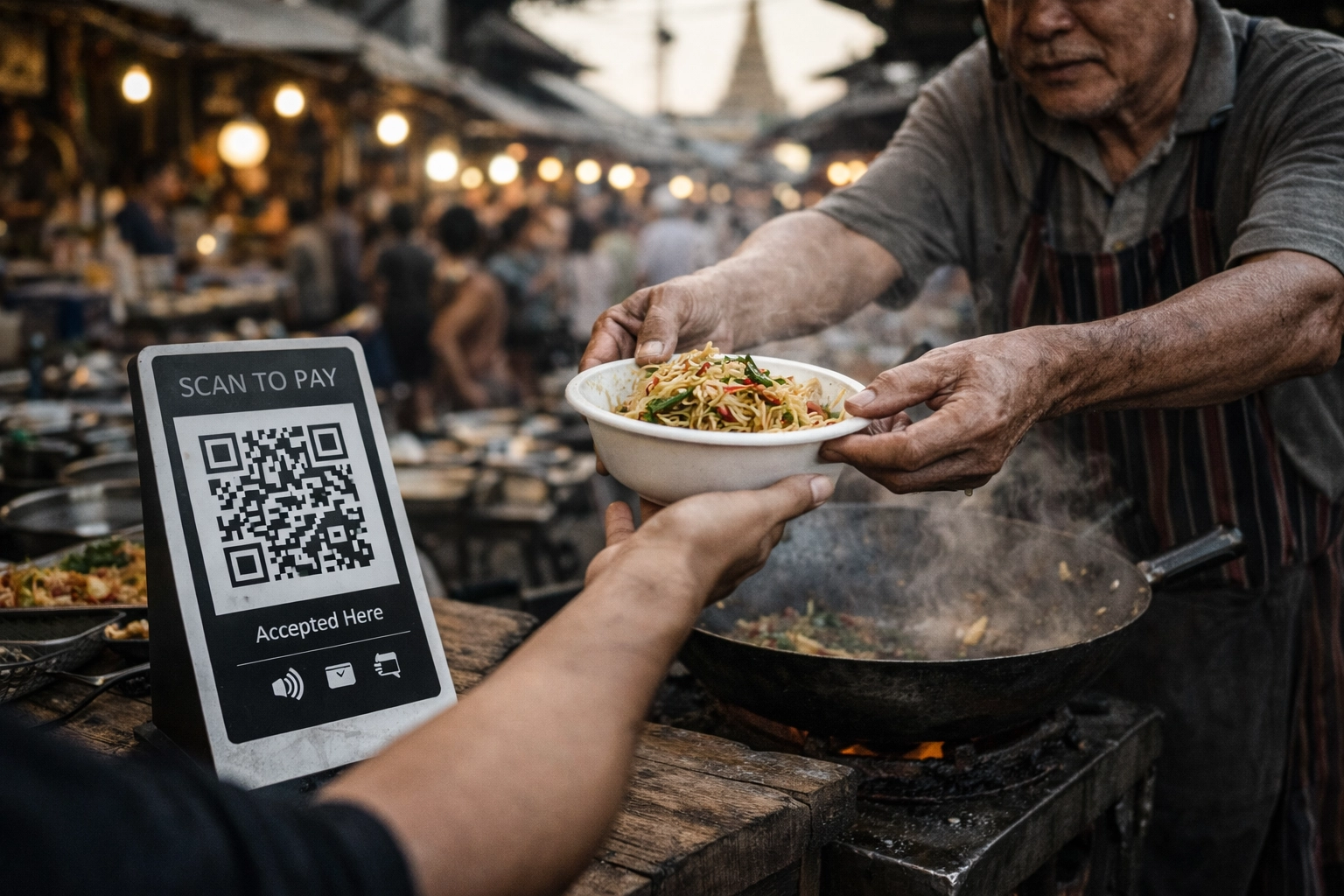
Prompt: Real news photography style, candid documentary shot in Bangkok: Thai street food vendor hands a steaming bowl of noodles to a customer; a small, real-looking QR code payment stand on a worn wooden counter; natural afternoon light, authentic textures and skin detail, shallow depth of field, no airbrushing, no CGI/AI look.
The Lumpini Blueprint: A 2026 Milestone
The Lumpini Hawker Center, scheduled to open its doors in 2026, serves as an anchor for this new urban strategy. Located in one of the city's most high-traffic districts, the center is designed to provide a "safe harbor" for vendors who have historically operated in the grey areas of municipal regulation. This facility is not just a building; it is a blueprint for urban sustainability.
The logic behind the project is rooted in the "density of intellectual exchange." By concentrating these vendors in a modern, organized facility, the city creates a hub where hygiene standards are standardized and logistics are streamlined. This is essential for a city competing for international MICE (Meetings, Incentives, Conferences, and Exhibitions) bids, where the expectations of global visitors often exceed what a traditional sidewalk stall can provide. In this context, Bangkok’s evolution mirrors efforts seen in other major hubs, such as Mexico City’s infrastructure boost for MICE bids, where the goal is to align local character with international professional standards.
Digital Scaffolding: Beyond the Cash Box
The most disruptive element of the Lumpini project is not the physical structure, but the digital scaffolding being erected around it. In the 20th-century model, a street food stall was a cash-only, hyper-local operation with a limited reach. In the 21st-century model being piloted for 2026, these stalls are becoming nodes in a digital ecosystem.
The integration of platforms like LINE MAN and the adoption of WeChat mini-programs represent a fundamental shift in how micro-vendors access the market. It is no longer about who walks past the stall; it is about the vendor’s visibility within the "digital urban grid." For instance, LINE MAN’s initiative to train riders in basic Chinese to facilitate orders from international tourists highlights a sophisticated bridge between local labor and global demand.
Furthermore, the transition to mobile payment systems: including PromptPay, Alipay, and WeChat Pay: removes the friction of traditional commerce. This digital transformation is a prerequisite for scaling. As we have seen with Singapore’s digital future and its trade framework upgrades for 2026, the ability to process data-driven transactions is what separates a survivalist business from a scalable one. In Bangkok, this means a vendor earning less than $500 USD a month can finally begin to leverage data to optimize inventory and predict demand.
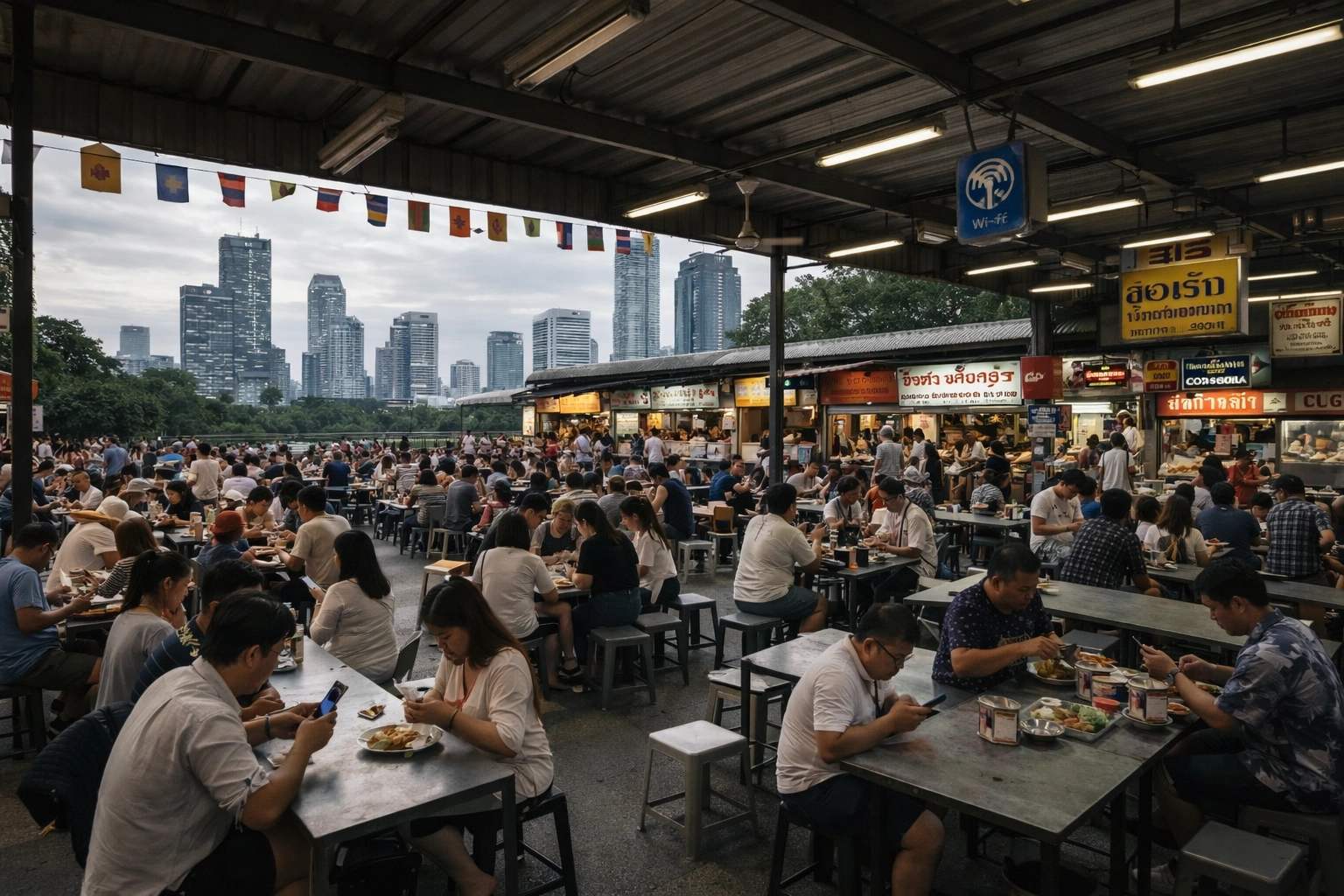
Prompt: Real news photography style, wide documentary photo of a modern open-air hawker center in Bangkok: mixed local and international diners, vendors at stalls, subtle smartphone ordering and QR signage visible, natural daylight, realistic materials and signage, imperfect candid composition, no render-like surfaces, no airbrushing, no AI artifacts.
The Hygiene of Scale: Standardizing the Spontaneous
One of the primary critiques of traditional street food is the lack of standardized hygiene and waste management. The Lumpini Hawker Center addresses this by providing "shared infrastructure": centralized cleaning facilities, grease traps, and waste disposal systems that a single sidewalk vendor could never afford or maintain.
This is the "Industrial-Community Fusion" logic at work. By centralizing these costs, the city allows the vendor to focus on their core competency: culinary craft: while the facility manages the externalities of food production. This shift is vital for maintaining Bangkok’s reputation as a world-class food capital. It is not merely about making the food safer; it is about creating an environment that invites a broader demographic of consumers, from high-net-worth business travelers to local office workers, into the same "nexus of consumption."
This strategy of professionalizing local sectors is a common thread among cities aiming for global leadership. Much like how Seoul is investing in global MICE hubs to create centralized locations for innovation, Bangkok is creating a centralized location for its most iconic cultural export.
The Value Chain of the Micro-Vendor
To understand the strategic importance of the Lumpini project, one must look at the data. In 2021, a significant portion of Bangkok’s street food vendors operated on margins that left them vulnerable to even minor economic shifts. Two-thirds of surveyed vendors earned less than $500 USD monthly. This financial precarity limits their ability to invest in "disruptive" technologies or expand their operations.
The Lumpini Hawker Center changes the math. By providing a stable location with built-in digital tools, the project reduces the "operational friction" that eats into these small margins. Digital tools allow for inventory optimization: AI-driven insights that help a vendor know exactly how many kilograms of pork to buy for a Tuesday afternoon versus a Friday night. This is not just "tech for tech's sake"; it is the application of enterprise-level logic to the micro-scale.
Global Urbanism and the Bangkok Nexus
The evolution of Bangkok’s street food is a case study in "Human Mobility" and the shifting nature of city-to-city dynamics. As cities become more alike in their glass-and-steel skylines, the "local soul": the street life: becomes their most valuable differentiator. The challenge for Bangkok is to preserve this soul while upgrading the "hardware" of the city.
The Lumpini project suggests that the future of urban development is not found in the total replacement of traditional models, but in their refinement. It is about creating "gateways" where the informal economy can interface with the formal global economy. This is a strategy being mirrored in tech hubs across the world, where the focus is shifting from massive corporate campuses to flexible, community-integrated hubs. We see a similar trend in the stabilization of tech markets in New York and San Francisco, where the focus is shifting toward sustainable, ecosystem-wide growth rather than unchecked expansion.
Conclusion: The Readiness of the Urban Grid
The Lumpini Hawker Center is a test of Bangkok’s organizational readiness for the future. By 2026, we will see if a megacity can successfully transition thousands of micro-entrepreneurs into a structured digital framework without losing the "fluidity" that made them successful in the first place.
For business leaders and urban strategists, the lesson is clear: Scaling the small is no longer an optional community project; it is a fundamental requirement for urban resilience. As the global economy becomes more digitized, the cities that can successfully bridge the gap between their most traditional assets and their most advanced infrastructure will be the ones that exert the strongest "gravitational pull" in the decades to come.
Is your organization prepared to engage with an economy where the smallest units are as digitally empowered as the largest corporations? The answer may lie in the steaming bowls of a Bangkok hawker stall.