Category: News
Tags: Seoul, K-Style/Design
Excerpt: Ahhorn isn't just selling clothes; they are re-engineering the DNA of Korean tradition for a global, modern audience. By blending 14 years of fashion expertise with a deep respect for heritage, they are proving that the most local stories are often the most universal.
The most consequential business connections of the 21st century aren't always found in boardroom skyscrapers or massive logistics hubs. Often, they are born in spaces the size of a small room: places where the "local-to-local" connection becomes a tangible reality. At bcdW Magazine, we’ve recently been obsessing over the idea of "a store the size of a room" and how it represents a limit-breaking philosophy. This brings us directly to the heart of Seoul and the doorstep of Ahhorn.
Ahhorn is not merely a fashion label. To view it as such is to miss the strategic catalyst at play. Ahhorn is a cultural translator. It is a bridge built between the deep, rhythmic heritage of the Korean Peninsula and the fast-paced, editorial demands of the modern global citizen. Led by a designer with over 14 years of industry experience, Ahhorn spent nearly a decade perfecting what they call "Ahhorn Hanbok": a platform that reimagines traditional Korean aesthetics for a world that no longer recognizes borders.
The Architecture of Tradition
When we talk about K-Design, the conversation often defaults to the "K-Wave" hype: bright colors, fast trends, and fleeting virality. Ahhorn rejects this script. Their approach is more clinical, more structural. They aren't interested in the costume-like novelty of traditional dress; they are interested in its civic infrastructure.
Traditional Hanbok is defined by its lines, its volume, and its relationship to the body. Ahhorn takes these elements and subjects them to a rigorous contemporary edit. The result isn't a "modernized" Hanbok in the sense of a compromise; it is a reimagining. It is the realization that the curves of a sleeve or the wrap of a bodice are not just historical artifacts: they are design solutions for grace, movement, and identity.
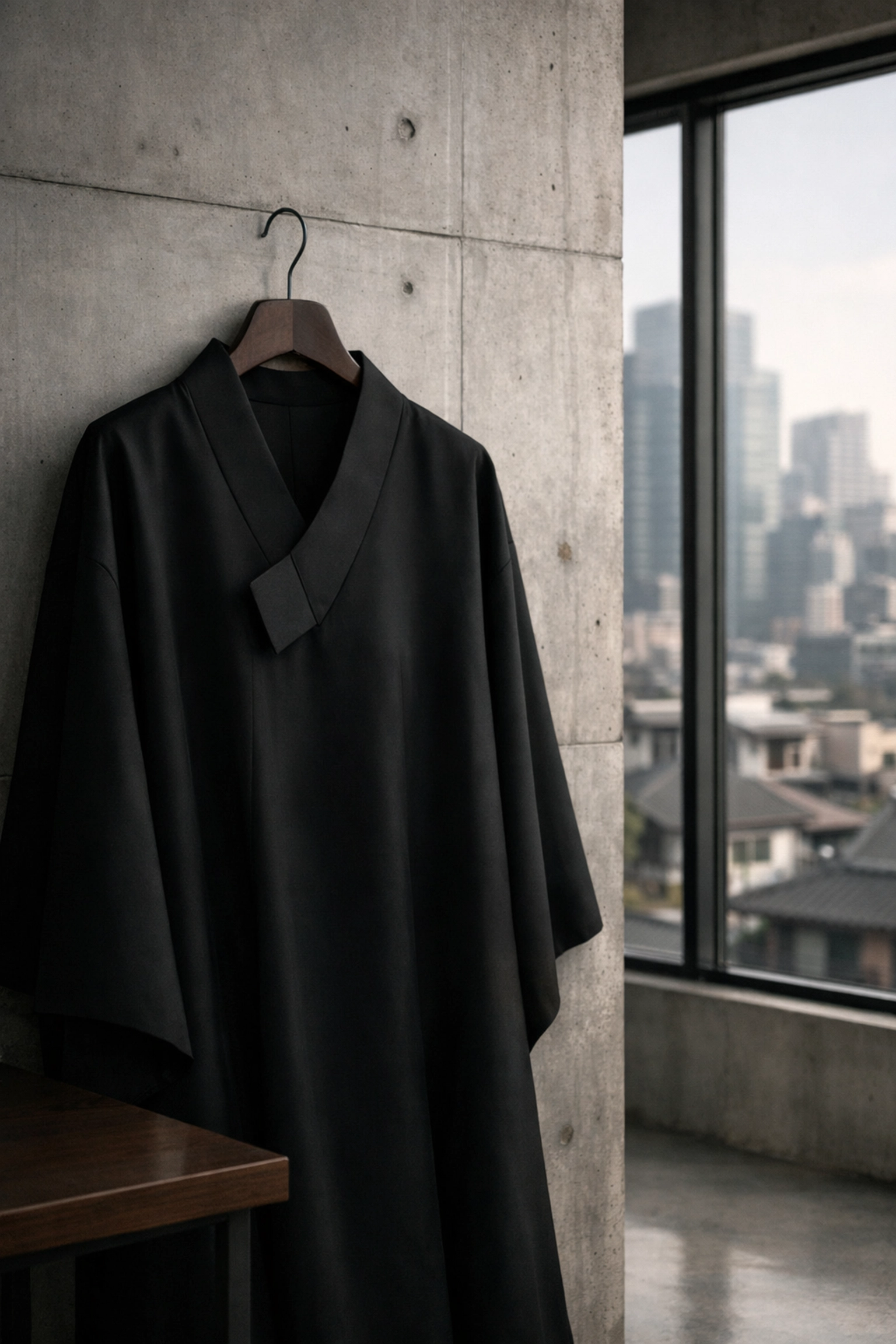
Photo: Ahhorn
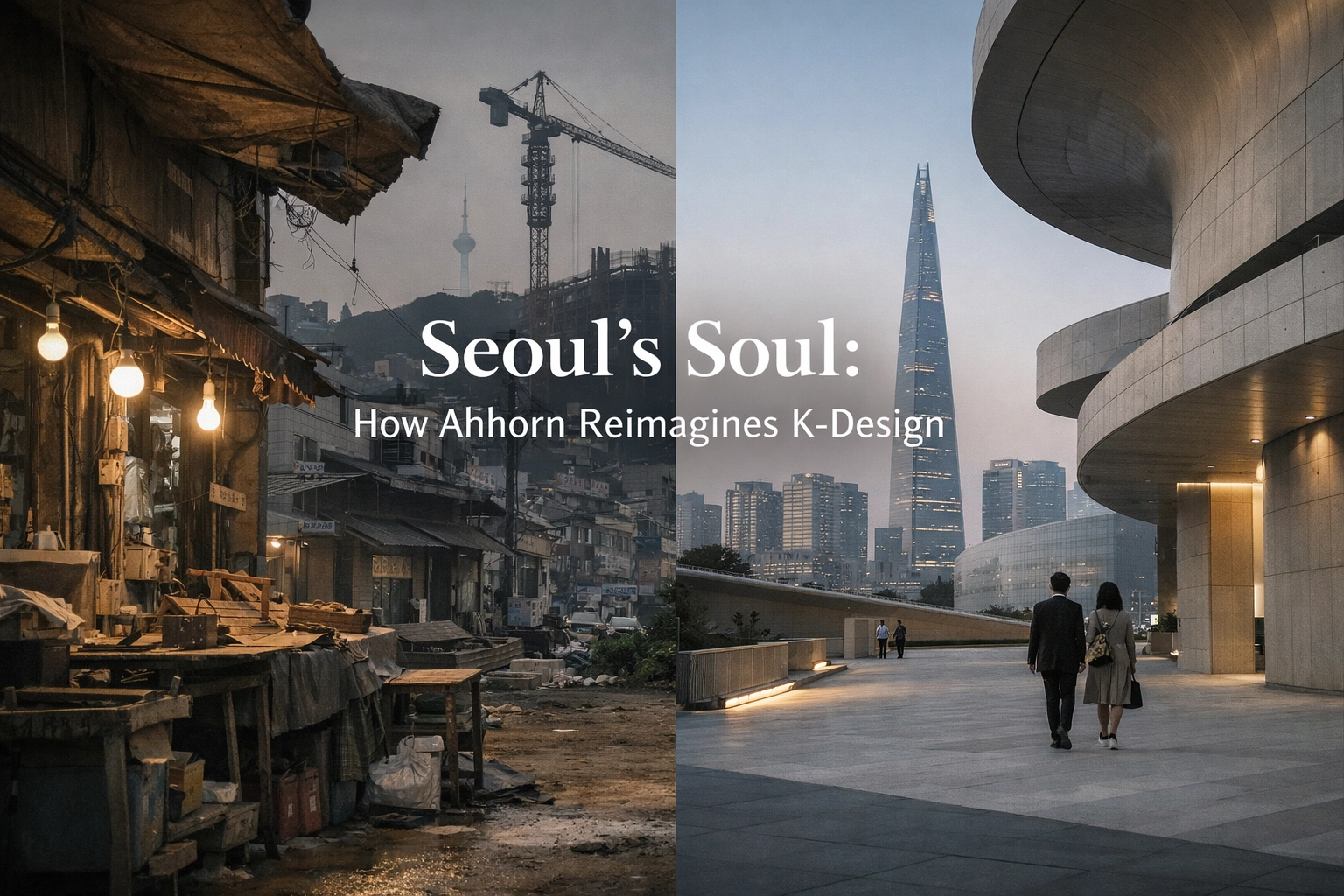
In their Summer Collection, captured against the backdrop of Seoul’s architectural juxtaposition, Ahhorn demonstrated how Korean design meets timeless editorial elegance. By stripping away the ornamental weight and focusing on the silhouette, they have created a vocabulary that speaks as clearly in the East Village of New York as it does in the districts of Seoul.
Not a Costume, But a Toolkit
At bcdW, we often use the "Not X, but Y" device to redefine market signals. In this case: Ahhorn is not selling a piece of Korean history; they are providing a toolkit for modern global identity.
Take, for example, their "Korean Design Black Dress Line." This is where the strategy becomes truly visible. The "Little Black Dress" is perhaps the most Western of fashion staples, a symbol of universal chic. By infusing this Western silhouette with the DNA of Korean tailoring: the subtle overlaps, the specific textures of Korean silk-blends, the minimalist gravity: Ahhorn has created a hybrid. It is a piece that allows the wearer to move fluidly between continents without losing their grounding in a specific culture.
This is the essence of what we call "Global Human Mobility" in our business ecosystem. It’s not just about moving people across borders; it’s about the movement of ideas and the ease with which a cultural identity can be worn in a new market. When a designer spends 14 years in the trenches of fashion, they learn that longevity isn't about being "new": it's about being "essential."
The Seoul-to-Americas Bridge
Seoul is a city that lives in the future while honoring a very specific, often painful past. This tension makes it the perfect laboratory for the kind of "Digital Bridge" work we do at bcdW. We believe that real business happens in cities, not countries. The connection between Seoul’s creative economy and the burgeoning markets in the Americas: from Los Angeles to Medellín: is a line of sight that many are failing to see.
In our recent coverage of Tigre de Salón and the MAMM store, we highlighted how local artisans in Medellín are finding global resonance through intentional, small-scale retail. Ahhorn operates on a similar frequency. Their participation in Seoul Fashion Week isn't just about the runway; it's about establishing a "Local-to-Local" connection.
Imagine a retail concept that bridges a Seoul-based Hanbok studio with an artisan footwear collective in Colombia. On the surface, they have nothing in common. Through the bcdW lens, they are identical: both are leveraging heritage to solve a modern design challenge. They are both creating "products of place" that are destined for a "global space."
The Strategy of Craft
Why does this matter to the strategist or the investor? Because the "manufactured in Asia, sold in America" model is dead. It has been replaced by a much more sophisticated "Designed in Seoul, Interpreted in New York, Worn in Bogotá" reality.
Ahhorn’s 9-year development of their Hanbok line is a masterclass in patient scaling. They didn't rush to the mass market. They stayed in the "room-sized" phase until the philosophy was bulletproof. They understood that to scale K-Design globally, you don't dilute the "K": you sharpen it until it becomes a universal edge.
This is the "Digital Bridge" in action. It is about taking virtual expertise: the 14 years of design knowledge: and acting as a local connector. Ahhorn acts as the coordinator for Korean culture, vetting which traditional elements are ready for global export and which need further refinement.
Where Do We Go From Here?
The question isn't whether K-Design will continue to influence global trends. The question is who will move first to integrate these aesthetics into the broader civic infrastructure of fashion.
Ahhorn has already shown the way. They’ve moved beyond the "K-Pop" aesthetic into something more enduring: what we call "K-Style" at bcdW. It is a style rooted in the soul of a city (Seoul) but designed for the momentum of a planet. It is cool, but not cold. It is intellectually engaged with its history but not trapped by it.
As we continue our "test voyage" at bcdW Current Today, we are keeping our eyes on brands like Ahhorn. They are the dots we love to connect: the ones that prove that a single room in Seoul can contain an idea that has absolutely no limit.
The bridge is open. The only thing left to do is walk across it.
Source: bcdW Magazine (https://bcd-w.xyz/p/a-store-the-size-of-a-room-an-idea-that-has-no-limit)