
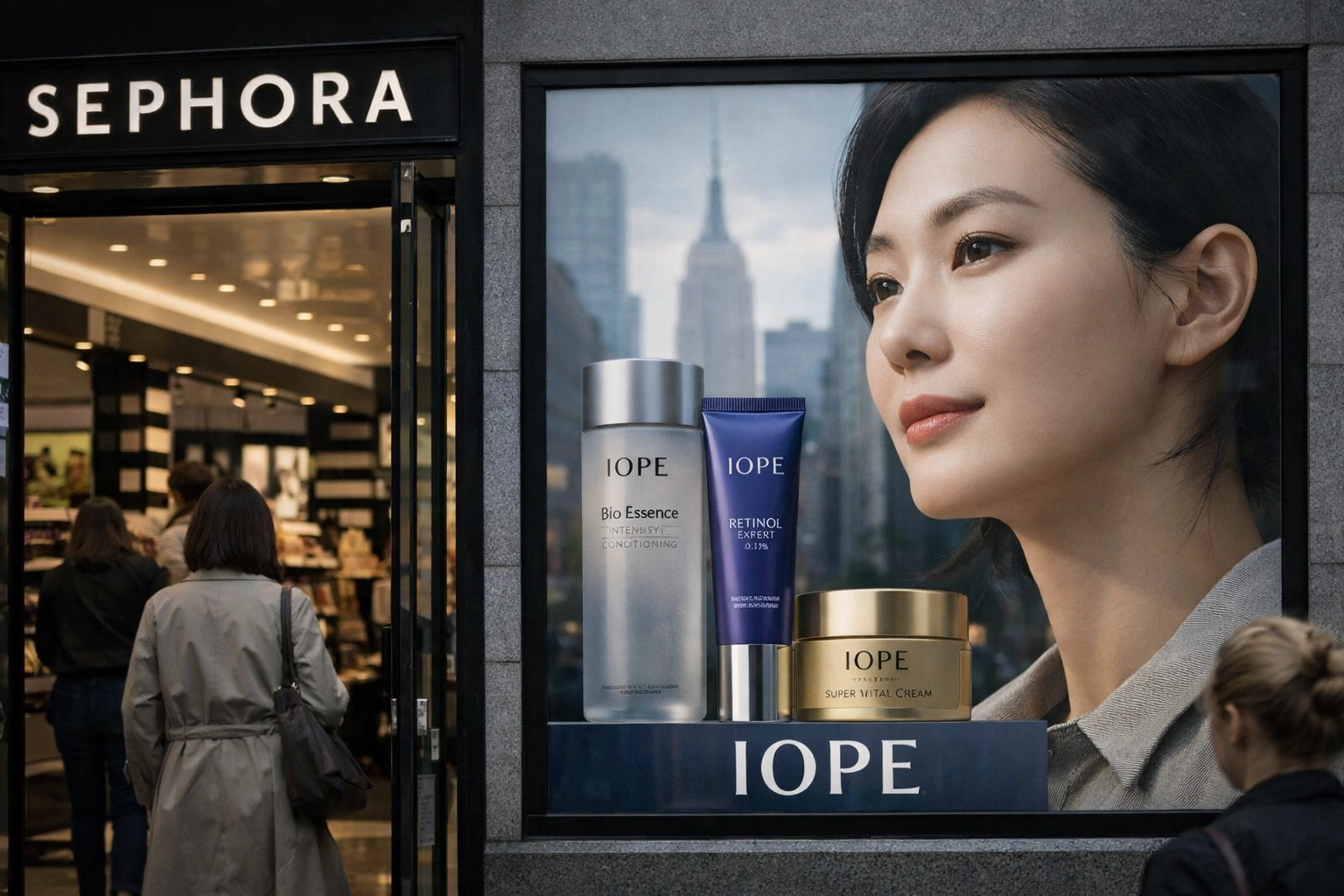
The narrative of Korean beauty in the United States just underwent a structural shift. For a decade, the "K-Beauty" label was synonymous with a specific aesthetic: sheet masks with playful illustrations, fruit-shaped containers, and the popularized "glass skin" routine. It was a trend driven by novelty. But on March 2, 2026, when Amorepacific’s IOPE landed on Sephora.com, followed by a nationwide rollout to all physical Sephora locations on March 13, that novelty era officially ended.
This is not just another brand launch. It is the arrival of clinical infrastructure from Seoul to the American shelf. IOPE is not selling a vibe; it is selling thirty years of accumulated R&D and patent-heavy retinol stabilization technology. By placing IOPE in every Sephora door, Amorepacific is signaling that the U.S. consumer is no longer looking for the "cute" export. They are looking for high-performance, medical-grade efficacy that can compete with, and perhaps outpace, established Western clinical brands.
The move marks a significant milestone for South Korean CPGs. We are witnessing the maturation of a bridge between the deep labs of Seoul and the premium retail corridors of North America. At bcdW, we track these shifts not as isolated marketing wins, but as signals of how innovation flows across the Pacific.
The End of the Aesthetic Era
For years, the U.S. market treated Korean skincare as a gateway drug to better skin: affordable, experimental, and fun. Brands like Innisfree and Laneige paved the way, focusing on hydration and sensory experiences. However, the "middle" of the market is disappearing. Today’s consumer is polarized: they either want the absolute lowest price or the highest possible performance.
IOPE sits firmly in the latter. Since its inception in 1996, the brand has functioned as the "science house" for Amorepacific. With 26 Korean patents and dozens of research papers on retinol alone, the brand's entry into Sephora represents a pivot toward "Clinical K-Beauty." The focus has moved from the surface level to the cellular level. This is a response to a more discerning American audience that reads ingredient lists like spreadsheets.
R&D as the Primary Export
The core of IOPE’s U.S. strategy lies in its Retinol RX™ and PDRN technology. In the high-stakes world of American skincare, retinol is the gold standard, yet it is notoriously unstable. IOPE’s competitive edge is its stabilization tech: ensuring the ingredient remains potent from the lab to the living room.
Consider the flagship products hitting Sephora shelves:
- Retinol RX™ 2% Reti-jection™ Serum: A product that uses retinol-infused spicules to mimic professional treatment delivery.
- XMD Stem III Clinical Recovery Serum: Formulated with a 92.3% PDRN H.A.™ complex, targeting the intersection of hydration and structural skin repair.
- PDRN Caffeine Shot Ampoule: A high-concentration liquid designed for immediate repair efficacy.
These are not "entry-level" products. With price points ranging from $57 to $69 for core serums, IOPE is positioning itself against the likes of Drunk Elephant and SkinCeuticals. They are betting that the "Made in Korea" label now carries enough scientific weight to command premium pricing in a saturated market. For more on how companies are navigating these competitive shifts, you can explore our archive.
The Sephora Gatekeeper
Retail is the ultimate validator. While direct-to-consumer (DTC) models allow for rapid testing, a nationwide Sephora rollout provides the physical "proof of life" required for a brand to become a household name in the U.S. For Amorepacific, this partnership is a strategic alignment. Sephora has spent the last three years aggressivey expanding its "Clinical Skincare" section, moving away from purely "Clean Beauty" to "High-Performance Beauty."
Giovanni Valentini, CEO of Amorepacific North America, summarized the sentiment perfectly: consumers are prioritizing visible results over marketing fluff. By securing a spot in every Sephora store, IOPE gains access to a pre-vetted audience of skincare enthusiasts who are already educated on ingredients like PDRN and Vitamin C.
This is a classic bcdW "dot-connecting" moment. A brand born in the suburbs of Seoul, refined through three decades of South Korean clinical trials, finds its scale in the shopping malls of the American Midwest and the high streets of New York. The infrastructure of beauty is being rewritten.

Bridging the Science Gap
The launch of IOPE is also a case study in how Asian CPGs are rethinking their global footprint. In the past, Korean brands would often "Westernize" their formulas or packaging to the point of losing their identity. IOPE is doing the opposite. They are leaning into their heritage as the "first" in many categories: the first to stabilize retinol in Korea, the first to launch the cushion compact (under the IOPE name originally).
This "first-mover" narrative is essential. The U.S. market is currently obsessed with "glass skin," but IOPE is offering something more substantial: "Skin Health." It is a shift from the temporary look to the long-term structural integrity of the skin. This mirrors a broader trend we’ve seen in other industries, where the focus moves from the product to the platform. IOPE isn't just a brand; it’s a delivery platform for Amorepacific’s most advanced research.
Those interested in how other sectors are utilizing similar "platform" strategies can look at our concept case studies.
The Strategic Convergence
What does this mean for the future of the U.S.-Korea business bridge?
First, expect a "Clinical Gold Rush." As IOPE proves the appetite for high-ticket Korean clinical gear, other conglomerates like LG Household & Health Care will likely follow suit, bringing their own R&D-heavy brands like CNP Laboratory or SUM37 into more aggressive Western distribution.
Second, the definition of "K-Beauty" will continue to fragment. We will see a clear divide between "K-Aesthetic" (low-cost, trend-driven) and "K-Clinical" (high-cost, R&D-driven). IOPE has successfully claimed the flag for the latter.
Finally, this launch validates the idea that innovation is no longer a one-way street from West to East. For decades, American brands set the clinical standard. Now, Sephora: the temple of Western retail: is looking to Seoul to provide the next generation of high-tech solutions.

The Bottom Line
IOPE’s entry into Sephora is a signal that the "Asian Century" of CPG is entering a new phase of maturity. It is a phase defined by patents over packaging and performance over personality. For professionals operating in the beauty, wellness, or retail sectors, the takeaway is clear: the barrier to entry in the premium U.S. market is no longer just a good marketing campaign. It is the ability to prove, through data and clinical trials, that your product does exactly what it says it will do.
At bcdW, we will continue to monitor how these connections evolve. Whether it’s a skincare lab in Seoul or an AI playbook in New York, the dots are always moving. The question is who will connect them next. To see more about how local innovations become global standards, visit our authors page or check out our latest insights.
The bridge is built. The products are on the shelves. Now, we watch the data.