Austin has long been a testing ground for the friction between digital acceleration and resource reality. As the capital of Texas transforms into a global epicenter for artificial intelligence, it faces a familiar, uncomfortable script: the insatiable appetite of data centers for freshwater and electricity. In a world where water scarcity is no longer a localized crisis but a systemic constraint on growth, the traditional model of industrial cooling is reaching its breaking point.
The launch of Waste2Nano LLC’s proprietary wastewater-cooled AI infrastructure in Austin represents more than a local utility upgrade. It is a fundamental redefinition of the relationship between urban waste and digital intelligence. By utilizing raw sewage as a primary cooling agent for AI data centers, the Austin-based company is proving that the most consequential innovations often lie in the convergence of the "invisible" civic infrastructure and the high-tech frontier.
The Thermal Paradox of the Silicon Hills
The narrative surrounding AI often floats in the ether: discussed in terms of tokens, neural weights, and abstract compute. But the reality is grounded in thermodynamics. For every breakthrough in generative AI, there is a corresponding heat signature that must be managed. Traditionally, this has meant diverting millions of gallons of potable water to evaporative cooling towers, a practice that is increasingly untenable in the drought-prone corridors of the American Southwest.
Waste2Nano’s entry into the Austin market challenges the assumption that digital growth must come at the expense of municipal stability. Their system does not view wastewater as a burden to be treated and discharged; it views it as a thermal and material asset.
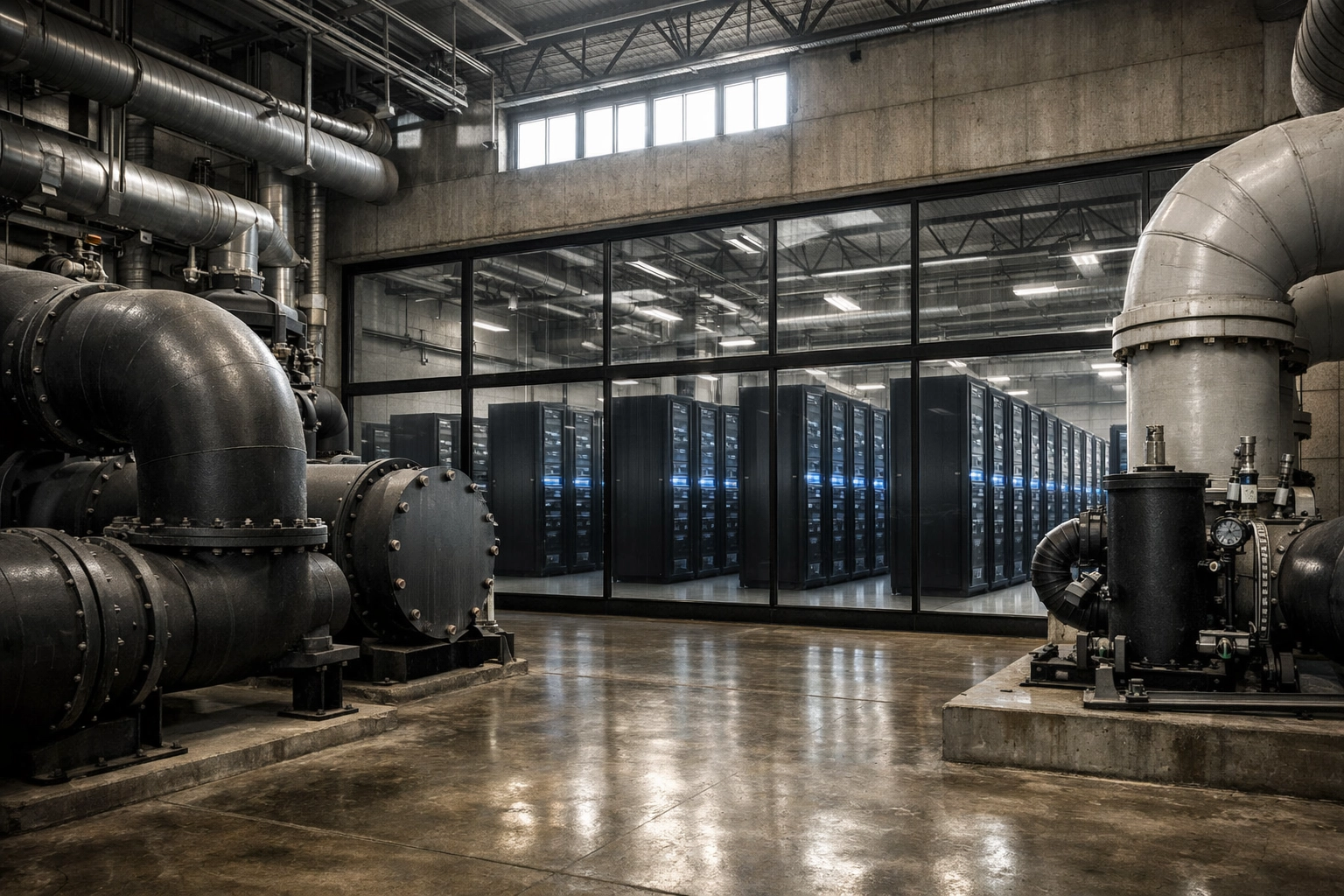
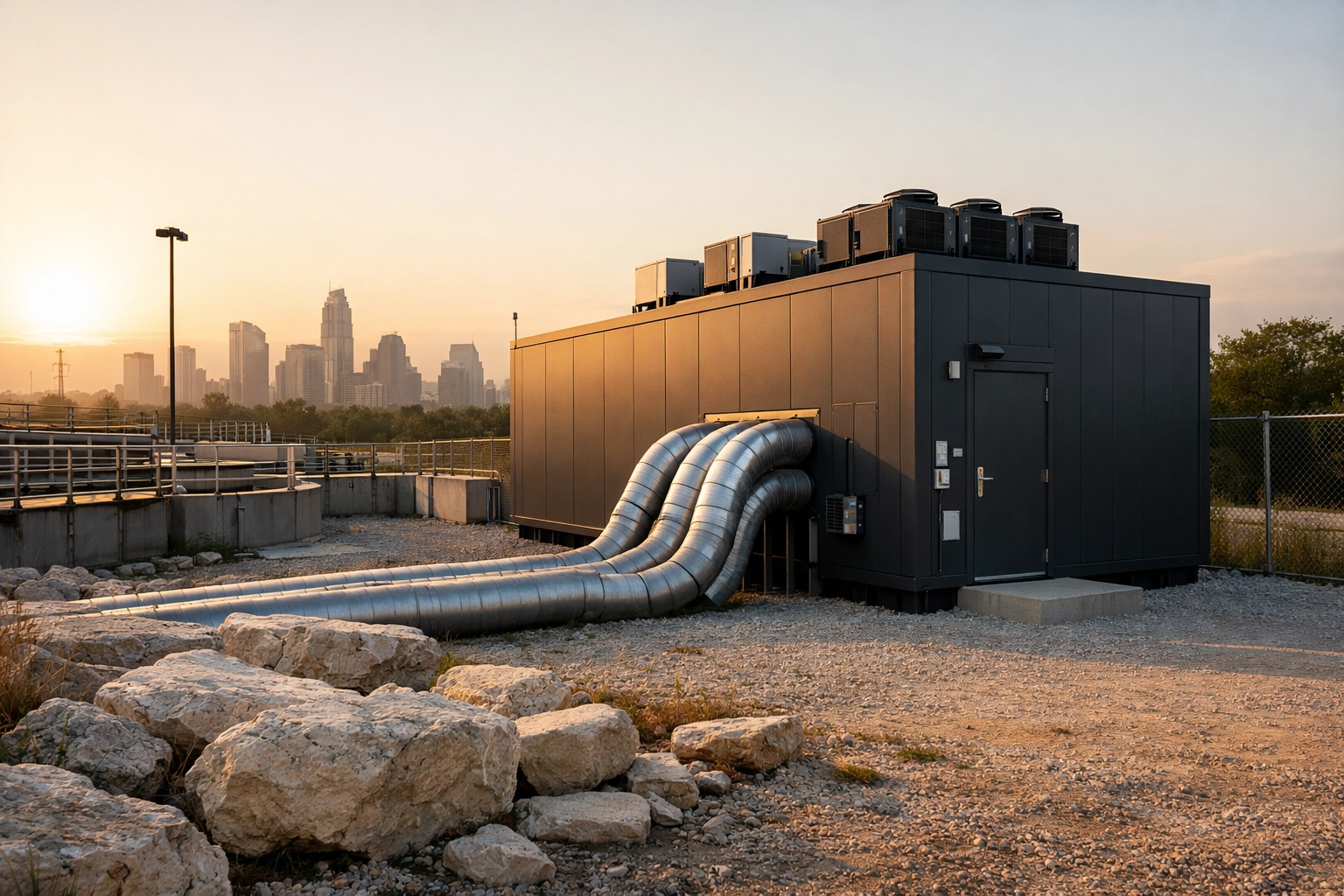
A documentary-style visualization of a high-tech cooling facility integrated within an urban wastewater treatment plant, showing the convergence of industrial pipes and server racks. Photo: Waste2Nano LLC / bcdW Magazine
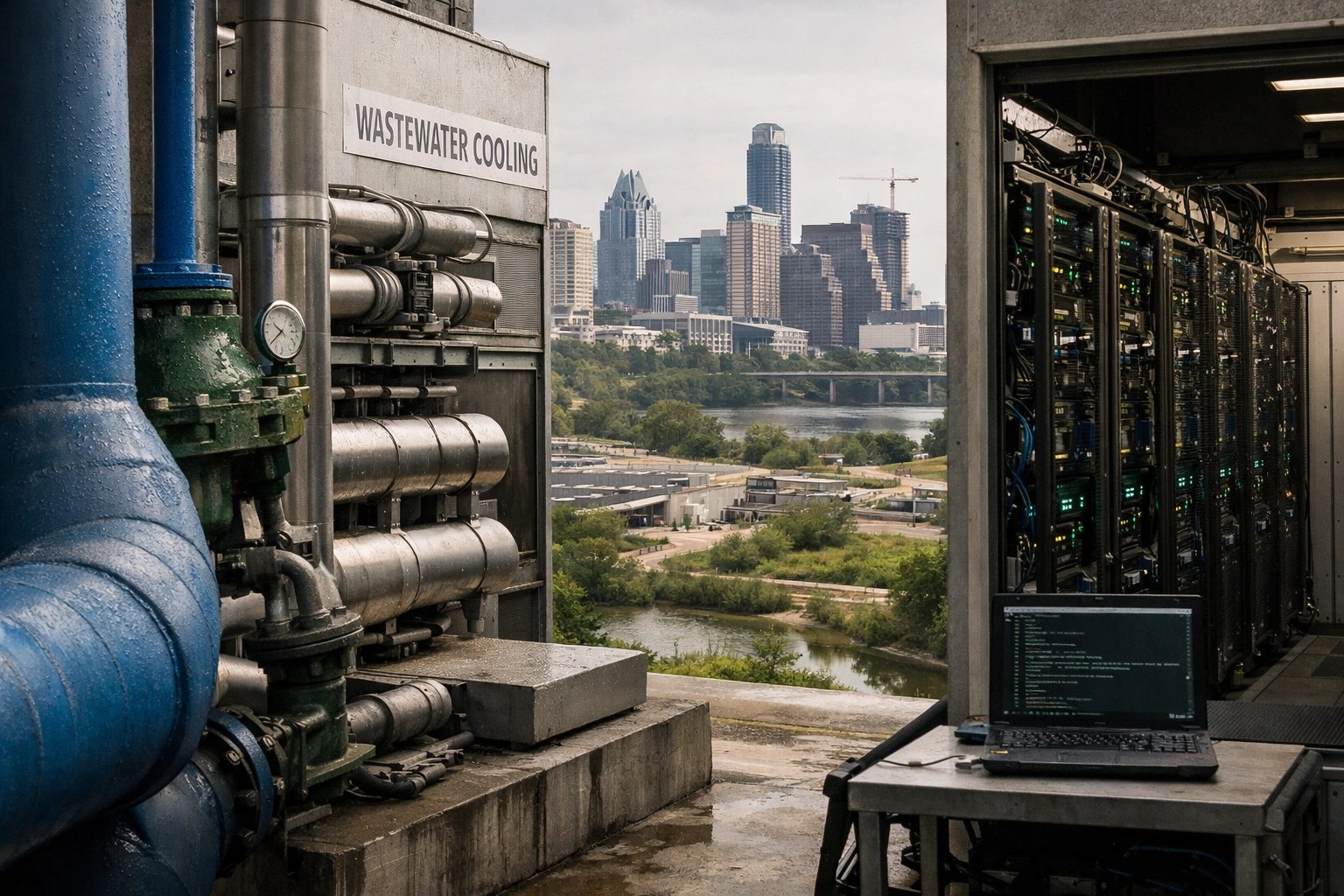
The platform operates through a closed-loop heat exchange process where raw wastewater: sewage: provides a reliable, high-capacity cooling source for data centers. Because the volume of municipal waste is constant and predictable, it offers a thermal stability that freshwater sources often lack. For a city like Austin, which must balance the needs of a booming population with the demands of tech giants, this represents a strategic catalyst for sustainable expansion.
Beyond Cooling: The Molecular Harvest
What distinguishes the Waste2Nano deployment from a standard industrial cooling project is its secondary metabolic function. The system integrates wastewater infrastructure with the production of advanced materials. As the raw sewage cools the AI servers, the resulting heat is captured and repurposed as energy for the conversion of sewage solids into MC/nanocellulose.
Nanocellulose is a high-performance material with applications ranging from aerospace to medical devices. By transforming biosolids: traditionally a costly byproduct for utilities to manage: into a valuable feedstock, Waste2Nano is effectively turning a waste stream into a revenue stream. This is not merely "green" branding; it is an exercise in complex economic engineering.
According to Dr. Refael Aharon, CEO of Waste2Nano, the average person produces 50–70 gallons of sewage daily. In a city of nearly a million people, that volume represents a massive, untapped reservoir of cooling potential and material feedstock. The Austin deployment is designed for a capacity of 10,000–20,000 m³/day, capable of supporting significant AI compute while producing several tons of nanocellulose daily.
Strategic Implications for the U.S. Market Entry Strategy
The decision to launch this first-of-its-kind infrastructure in Austin is a calculated move within a broader U.S. market entry strategy. For infrastructure companies emerging from specialized research hubs, the challenge is rarely the technology itself, but the integration into existing civic frameworks. Austin provides the perfect intersection of a progressive regulatory environment, a desperate need for water-efficient cooling, and a high concentration of AI operators.
For bcdW, this project serves as a case study in how cities can act as the primary unit of connection. The model established here: integrating data center cooling with municipal waste recovery: is a blueprint that can be exported to other high-density, water-stressed hubs. From the arid regions of the Southern Cone to the rapidly urbanizing centers of Southeast Asia, the "Austin model" offers a way to decouple digital infrastructure from freshwater consumption.
A schematic architectural rendering showing the closed-loop flow between a municipal sewage line, a heat exchange unit, and a modular AI data center. Photo: Waste2Nano LLC / bcdW Magazine
When we analyze the concept case studies of the next decade, the focus will not be on standalone software, but on "thick" infrastructure that solves multiple problems simultaneously. Waste2Nano isn't just selling a cooling system; they are providing a solution for sludge management, a source for advanced materials, and a pathway for AI scaling that doesn't deplete the local reservoir.
The Invisible Infrastructure of the Future City
We often speak of the "Smart City" as a layer of sensors and data. But the truly smart city is one that optimizes its physical metabolism. The Austin deployment utilizes portable units that can be integrated into existing wastewater treatment plants and data-center environments without disrupting core operations. This modularity is essential for rapid scaling.
The economics are compelling. By lowering the cost of cooling and generating a marketable byproduct (nanocellulose), the plant economics shift from a cost-center to a profit-center. For municipalities, this reduces the rising costs of biosolids and sludge management: a significant portion of any city’s utility budget. For AI developers, it secures a "future-proof" cooling source that is resilient to water restrictions and environmental scrutiny.

A close-up, realistic shot of nanocellulose material produced from the Waste2Nano process, emphasizing its advanced, industrial application. Photo: Waste2Nano LLC / bcdW Magazine
This is the "dot-connecting" that bcdW tracks. It is the convergence of the most mundane aspect of human life: sewage: with the most advanced aspect of human achievement: AI.
A Bridge Between Continents
While Austin is the beachhead, the implications of wastewater-cooled infrastructure are global. As we navigate the archive of industrial shifts, we see a pattern: the most successful technologies are those that turn a liability into an asset.
In many Asian markets, where urban density is even higher than in the U.S., the Waste2Nano model could be revolutionary. Cities like Jakarta or Manila, which face immense challenges in waste management and energy stability, could leapfrog traditional data center designs by adopting this integrated approach. The bcdW Rainmaker Program is designed precisely for these types of cross-continental transitions: connecting vetted execution partners with the municipalities that need them most.
The question for the next generation of founders and investors is not whether AI will continue to grow. It is where that growth will be physically located. The cities that win will be those that can provide the thermal and electrical capacity to house the machines of the future without bankrupting their natural resources.
The New Civic Framework
Waste2Nano’s launch in Austin is a signal that the era of "dumb" infrastructure is ending. We are moving toward a civic framework where systems are multi-functional, closed-loop, and deeply integrated. A data center should not be a black box that consumes resources; it should be a node in the city’s industrial ecosystem.
As this technology matures, expect to see it mentioned in conferences and conversations across both hemispheres. It represents a rare alignment of interests: municipal leaders seeking to reduce waste costs, tech companies seeking to secure cooling, and investors seeking sustainable ESG-compliant assets.
Austin has made its move. The dots have been connected between the sewage line and the server rack. The question now is which city will be the first to follow its lead.
Summary: Waste2Nano LLC has launched a groundbreaking wastewater-cooled AI infrastructure in Austin, Texas. The system uses raw sewage to cool data centers, captures waste heat to produce high-performance nanocellulose from biosolids, and offers a sustainable path for AI expansion in water-stressed urban environments.
Excerpt: Austin's new wastewater-cooled AI infrastructure by Waste2Nano LLC redefines urban metabolism by turning sewage into a cooling asset and a source for advanced materials. This first-of-its-kind deployment signals a shift toward integrated, closed-loop civic infrastructure for the AI era.
Source: Waste2Nano LLC (https://waste2nano.com/news/austin-launch-2026)