Category: News
Tags: Los Angeles, Fashion/Sustainable
Excerpt: From a Santa Monica garage to the high-energy streets of Medellín, Christy Dawn is redefining what it means to go global by staying local. This is the story of why the iconic Venice Beach brand bypassed traditional retail hubs to find its home in "The Room."
Geography is a funny thing in the 21st century. We’ve spent decades believing that "global expansion" meant a glass-and-steel flagship on Fifth Avenue or a sprawling storefront in a London high-street. But the map is being redrawn. Today, the most consequential business connections aren't happening between nation-states or corporate monoliths; they are happening between specific rooms in specific cities.
When Christy Dawn, the Venice Beach-born pioneer of "farm-to-closet" fashion, decided to make its mark in Medellín, Colombia, it didn't look for a shopping mall. It looked for a room. Specifically, it looked for The Room: the intimate, high-concept space curated by Tigre de Salón at the MAMM (Medellín Museum of Modern Art).
This isn't just a retail story. It’s a case study in what we at bcdW call "local-to-local" connectivity. It is the realization that a brand born in a California garage has more in common with an artisan workshop in Antioquia than it does with a mass-market distributor in its own backyard.
The Lincoln Boulevard Blueprint
To understand why Christy Dawn fits so perfectly in Medellín, you have to understand where they started. Before they were a darling of the sustainable fashion world, Christy Dawn and co-founder Aras Baskauskas were running a "cottage business" out of a garage in Santa Monica.
When they finally decided to move into a physical boutique, they didn’t head for the polished floors of a luxury plaza. They chose Lincoln Boulevard in Venice. At the time, Lincoln was the "new" Abbot Kinney: gritty, emerging, and filled with a specific kind of creative energy. It offered cheaper rent and easier parking, sure, but more importantly, it offered a community aesthetic that felt authentic.
This move from a garage to a community-centric street was a signal. It told the world that Christy Dawn wasn't interested in being everywhere; they were interested in being somewhere that mattered. They understood that the country sets the rules, but the city: and the neighborhood: makes the deals. This philosophy of intentional placement is exactly what led them to the heart of Medellín’s creative transformation.
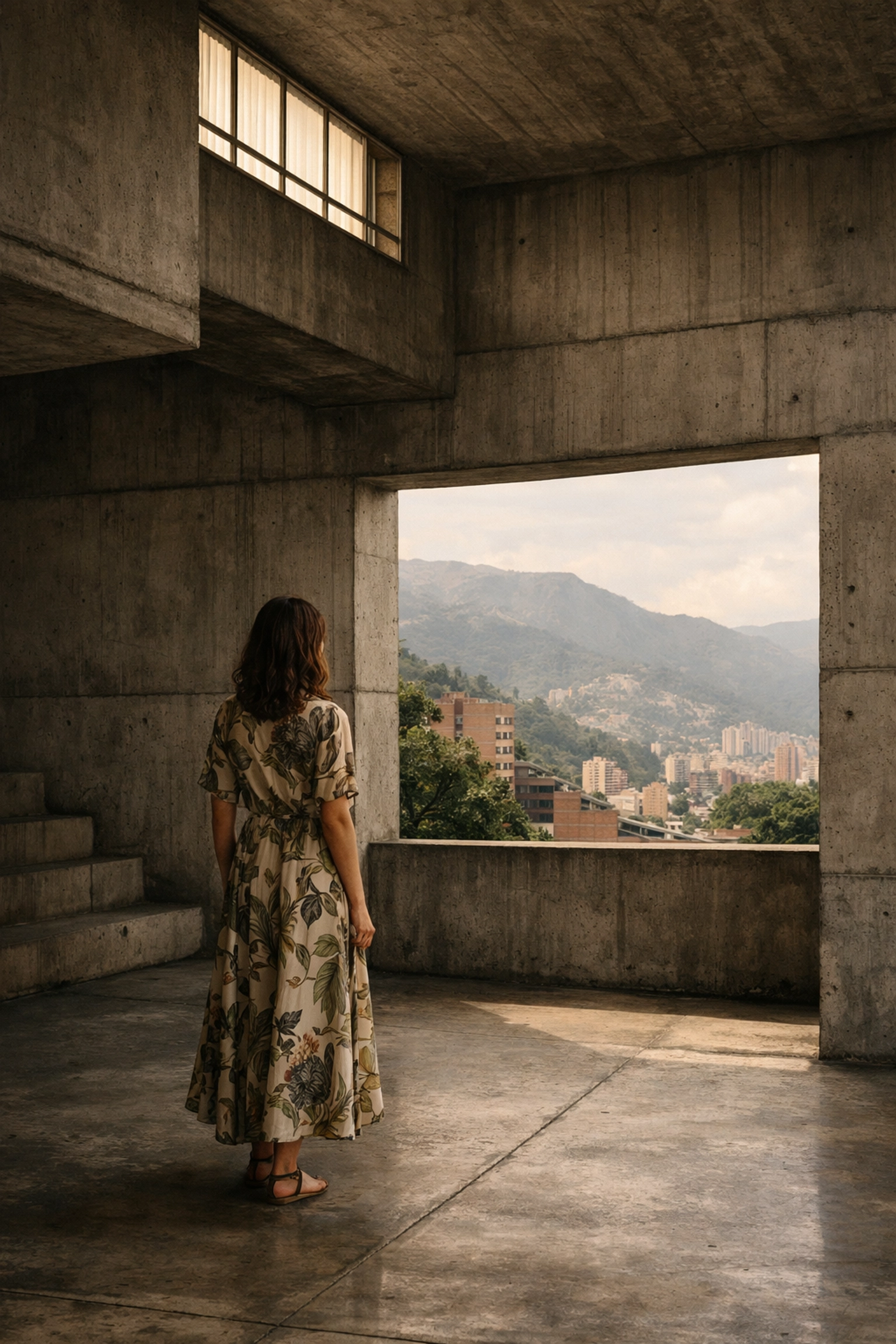
Photo: Christy Dawn
Not a Store, But a Convergence
The decision to join "The Room" in Medellín is a masterclass in strategic alignment. As we’ve explored in our deep dive into A Store the Size of a Room, the concept of "The Room" isn't about square footage. It’s about the density of the idea.
For Christy Dawn, Medellín represents a mirror image of the Venice Beach ethos. Both cities are creative powerhouses undergoing rapid structural shifts. Medellín, once defined by its "familiar script" of conflict, is now a global hub for design, tech, and "human mobility." It is a city that has redefined its civic infrastructure through the lens of art and community.
By placing their regenerative dresses alongside the indigenous-inspired crafts of Tigre de Salón, Christy Dawn isn't just selling clothes. They are participating in a "convergence." It is the Americas-to-Americas bridge in action. They are connecting the dots between the regenerative cotton fields of their supply chain and the ancestral weaving techniques of the Colombian highlands.
The "Farm-to-Closet" Infrastructure
At bcdW, we often talk about "depth over speed." Christy Dawn embodies this. Their commitment to sustainability isn't a marketing layer; it’s a structural foundation. They aren't just using organic cotton; they are investing in the soil itself.
This level of systemic thinking is exactly what resonates in the Medellín ecosystem. The local artisans and designers in Colombia aren't looking for "fast fashion" partners. They are looking for collaborators who understand that a product is only as good as the community it supports.
In "The Room," the transaction is secondary to the connection. A customer in Medellín buying a Christy Dawn piece isn't just participating in Los Angeles style; they are supporting a global network of ethical production that respects the local hand. It is a "dot" that connects a farm in India, a design studio in Venice, and a museum shop in Medellín.
Why the "Room" Works
Traditional retail is a logistical problem; "The Room" is a design solution. In an era where e-commerce accounts for over 60% of sales for brands like Christy Dawn, the physical space has to do something the digital space cannot. It has to provide a "vibe."
Venice Beach has a vibe that is impossible to replicate in a digital shopping cart. It’s the salt air, the mid-century modern furniture, and the sense that you are part of a movement. "The Room" at MAMM provides that same intangible value. It is a curated environment where the furniture, the lighting, and the neighboring brands all speak the same language of "sophisticated intelligence."
This city-to-city connection: Los Angeles to Medellín: works because both locations treat their retail spaces as "civic infrastructure." They are places where people gather to see what the future looks like. For Christy Dawn, "The Room" is the perfect laboratory to test how a brand with a deep sense of place in California can translate that soul into a new geographic context without losing its identity.
The Strategy of Smallness
There is a temptation for brands that find success to "go big." But the most successful companies in the 21st century are finding that "going deep" is more profitable. By keeping the physical footprint small, literally the size of a room: Christy Dawn maintains the "cottage business" intimacy that made them famous in the first place.
This is a lesson for any founder or investor looking at the space between markets. Don't look for the biggest mall in Seoul or Jakarta. Look for the room where the conversation is already happening. Look for the "strategic catalyst" that allows you to plug into an existing community rather than trying to build one from scratch.
Christy Dawn's presence in Medellín is a signal that the bridge between the Americas is strengthening. It’s a reminder that when we connect the dots between our cities, we create an economy that is more resilient, more sustainable, and infinitely more interesting.
Final Thoughts: The View from the Bridge
As we continue our "test voyage" at bcdW Current Today, we are constantly looking for these signals. The arrival of an iconic Venice Beach brand in a curated Medellín room is more than a fashion update; it’s a shift in the tectonic plates of retail.
It tells us that the "Local-to-Local" model is no longer a theory. It is happening. The designers in Medellín are watching Los Angeles, and the creators in Venice are finding inspiration in the mountains of Colombia. The dots are connected. The question is: who moves next?
Whether you are an operator in Vancouver or a strategist in Buenos Aires, the lesson of Christy Dawn is clear: the most important business you will do this year might not be in a boardroom. It might just be in a room.
Source: bcdW Magazine (https://bcd-w.xyz/p/a-store-the-size-of-a-room-an-idea-that-has-no-limit)