The checkout line at a Safeway in suburban Phoenix doesn't usually look like a laboratory for geopolitical cultural arbitrage. But when a consumer reaches for a bright purple package of Samyang’s Buldak Birria ramen, they aren’t just buying a quick lunch. They are participating in a sophisticated cross-continental convergence.
For years, the Consumer Packaged Goods (CPG) industry operated on a model of "localization": taking a global brand and tweaking a minor ingredient to suit local palates. Samyang Foods has inverted this script. They aren't localizing; they are platforming. By merging the aggressive heat of Korean buldak (fire chicken) with the slow-cooked, savory soul of Mexican birria, Samyang is demonstrating how a food product can function less like a commodity and more like a piece of high-growth Intellectual Property (IP).
This is the "Swicy" economy in its most aggressive form. It is the point where Seoul’s manufacturing agility meets the demographic gravity of the Americas.
The Noodle as an Operating System
To understand why a Korean company is suddenly obsessed with a traditional meat stew from Jalisco, one must stop looking at Buldak as a noodle brand. In the bcdW framework, we view Buldak as an operating system.
In the software world, an OS provides the core functionality: the interface, the security, the "feel": while allowing third-party developers to build specialized applications on top of it. Buldak’s core "code" is its signature heat profile and chewy texture. The "applications" are the flavor variants: Carbonara for the creamy-obsessed, Habanero Lime for the zesty, and now, Birria for the fusion-forward.
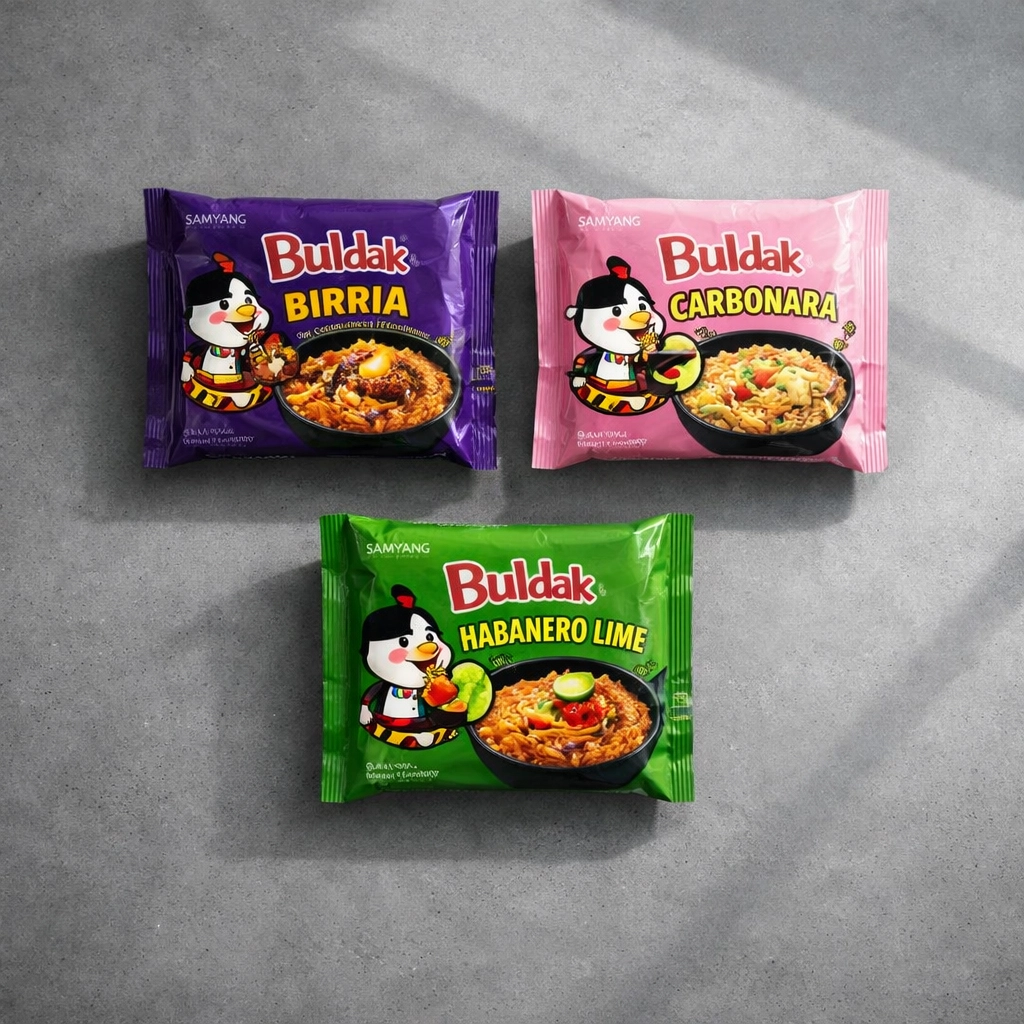
Samyang’s strategy is a masterclass in treating a flavor profile as a Global IP. Much like a Marvel movie franchise adapts its characters to different cultural contexts without losing the core "hero" essence, Samyang adapts Buldak. The Birria launch isn't a shot in the dark; it is a calculated expansion into the Hispanic market, the fastest-growing demographic in the United States. By adopting the Birria flavor: a trend that exploded on TikTok and moved from taco trucks to fine dining: Samyang is skip-tracing the traditional CPG lifecycle. They are moving at the speed of internet culture, not the speed of traditional supply chains.
The Demographic Bridge: Seoul to East L.A.
The connection between the Korean Peninsula and the American Southwest is not as disparate as it appears on a map. Both cultures share a profound reverence for heat, a history of transformative street food, and a consumer base that values "intensity" over "subtlety."
When Samyang launched the Birria variant exclusively through Albertsons-owned chains: Safeway, Vons, and Jewel-Osco: it was a surgical strike. These retailers have a deep footprint in regions with high Hispanic populations. This is Concept & Case study in demographic mapping. Samyang didn't aim for the mass market immediately; they aimed for the cultural gatekeepers.
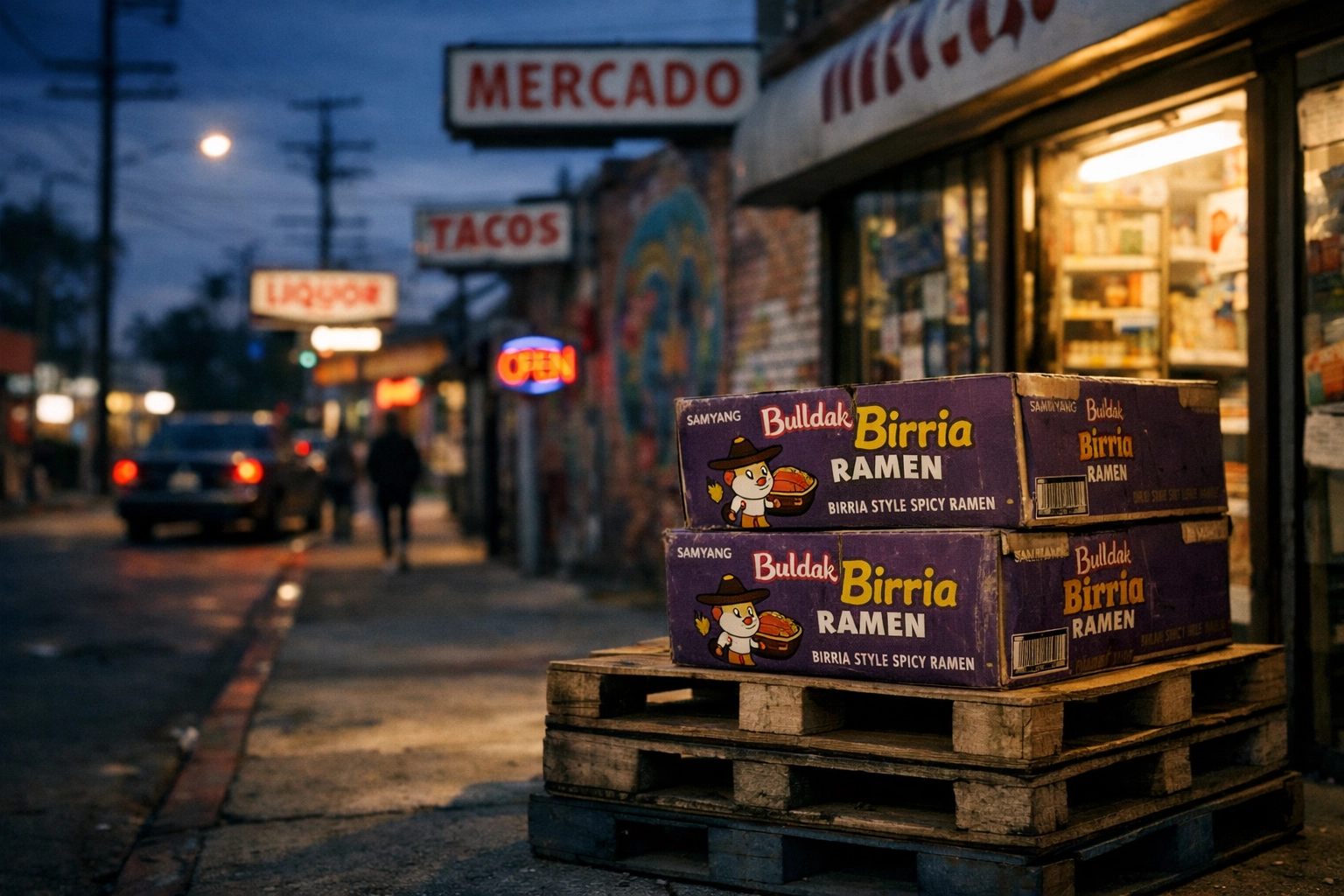
Birria is more than a flavor; it is a signal of belonging. By validating the Hispanic palate through a high-status Korean export, Samyang creates a feedback loop of cultural cool. The Birria ramen delivers an authentic beef-heavy umami that belies its "chicken flavored" roots, a feat of food engineering that earned it a perfect 5.0 from the industry’s most rigorous critics. This isn't just "fusion food": it is the elimination of borders through the medium of sodium and spice.
The Death of the Middle and the Rise of "High-Performance" CPG
The CPG landscape in 2026 is witnessing a radical polarization. As we’ve noted in our analysis of San Francisco’s retail experiments, the "middle" is disappearing. Consumers are either buying the cheapest possible private-label commodity or they are spending a premium on "high-performance" experiences.
Buldak sits firmly in the latter. It is not "cheap" ramen. It is a challenge. It is an event. It is a "Swicy" (sweet and spicy) performance that consumers document and share. This shift from "sustenance" to "content" is why Samyang’s U.S. sales surged by over 50% in the last year. They are not competing with Maruchan; they are competing with Netflix and TikTok for a share of the consumer’s dopamine.
This is where the bcdW Rainmaker Program sees the most opportunity: in the space where Asian manufacturing prowess meets the American thirst for "the new." Samyang’s ability to iterate on a flavor and bring it to market in months, rather than years, is a form of scalable agility that legacy American CPG companies are currently struggling to replicate.
Scalable Agility: The New Competitive Advantage
Why can Samyang do this while others falter? The answer lies in their organizational structure. Most CPG giants are bogged down by a "US-centric" framing that views international flavors as "ethnic" or "niche." Samyang, standing in the center of the Asia-Americas bridge, views the world as a singular, interconnected marketplace.
They understand that a trend in Mexico City will inevitably vibrate through Los Angeles and eventually land in Seoul. By the time it reaches Seoul, Samyang has already formulated the response. This is the essence of what we do at bcdW: we reveal these connections before they become common knowledge.
The Birria variant is a product of this agility. It occupies the middle ground of the spice spectrum: more approachable than the original 2x Spicy but more "authentic" than the Carbonara. It is a gateway drug for the uninitiated, designed to pull the mainstream Hispanic consumer into the Buldak ecosystem. Once they are in, the "IP" does the rest of the work.
The Infrastructure of Flavor
We often talk about "civic infrastructure" or "urban frameworks" in our City columns, but there is also such a thing as "flavor infrastructure." This is the network of supply chains, influencers, and retail partnerships that allow a specific taste to dominate the global consciousness.
Samyang has spent the last decade building this infrastructure. They didn't just sell noodles; they built a community. They leveraged the "Fire Noodle Challenge" to turn consumers into unpaid marketing departments. Now, they are using that infrastructure to port in new "content" like Birria.

This model is remarkably similar to how we view the Digital Bridge consulting model. It starts with a virtual presence (the social media hype), moves into a connector phase (exclusive retail partnerships), and ends with full-scale coordination (mass-market dominance). Samyang is no longer just a food company; they are a logistics and media house that happens to sell ramen.
Beyond the Bowl: What’s Next?
The Birria play is a signal. It tells us that the future of CPG is not found in global homogenization, but in aggressive, hyper-local fusion. It tells us that the most successful companies of the next decade will be those that can stand in the middle of two continents and see the lines between them.
Expect Samyang to continue this "IP" expansion. We might see a Miso-Chipotle variant, or perhaps a Korean-BBQ-Carnitas hybrid. The specific flavor is almost secondary to the methodology. The methodology is: Find a cultural anchor, wrap it in the Buldak brand, and deploy it through a high-agility supply chain.
As we look toward the future of business consulting and market entry, the Samyang case study offers a clear lesson. A product is not just a physical object. It is a bridge. It is a conversation between Seoul and Chicago, between the history of a Korean spice and the future of an American demographic.
The question for other CPG leaders isn't whether they can make a better noodle. The question is: do you have the infrastructure to turn your product into a global IP? Or are you still just selling lunch?
The dots are there. Samyang just happened to connect them with a bit of birria broth.