Singapore is not merely expanding its hospitality footprint; it is re-engineering the very architecture of global commerce. In a move that signals a profound shift in how city-states anchor their economic relevance, the Singapore Tourism Board (STB) has unveiled its Tourism 2040 roadmap. The headline figure is staggering: a strategy designed to triple MICE (Meetings, Incentives, Conventions, and Exhibitions) tourism receipts by 2040.
This is not a modest adjustment to a successful model. It is a wholesale bet on the city as a high-yield strategic catalyst. By positioning itself as the world’s premier business events destination, Singapore is making a clear statement: in an increasingly digital world, the physical convergence of human capital remains the ultimate economic driver.
The Economics of High-Yield Convergence
At the heart of this roadmap lies a clinical understanding of the value of a business traveler. In 2024, Singapore recorded tourism receipts of S$29.8 billion. The 2040 target pushes the total tourism ceiling toward S$50 billion. Within this framework, the MICE sector is the primary engine.
The rationale is grounded in a singular, powerful metric: business event attendees typically spend twice as much as leisure visitors. A convention is not just a gathering of professionals; it is a concentrated injection of high-value consumption, intellectual exchange, and secondary deal-making. For a city with limited land but unlimited ambition, the MICE sector represents the highest possible return on every square meter of urban space.
This tripling of revenue requires more than just more people; it requires a different kind of visitor. It necessitates a focus on global mobility consulting and the seamless movement of high-level talent across borders: a core component of bcdW's own Global Human Mobility Program.
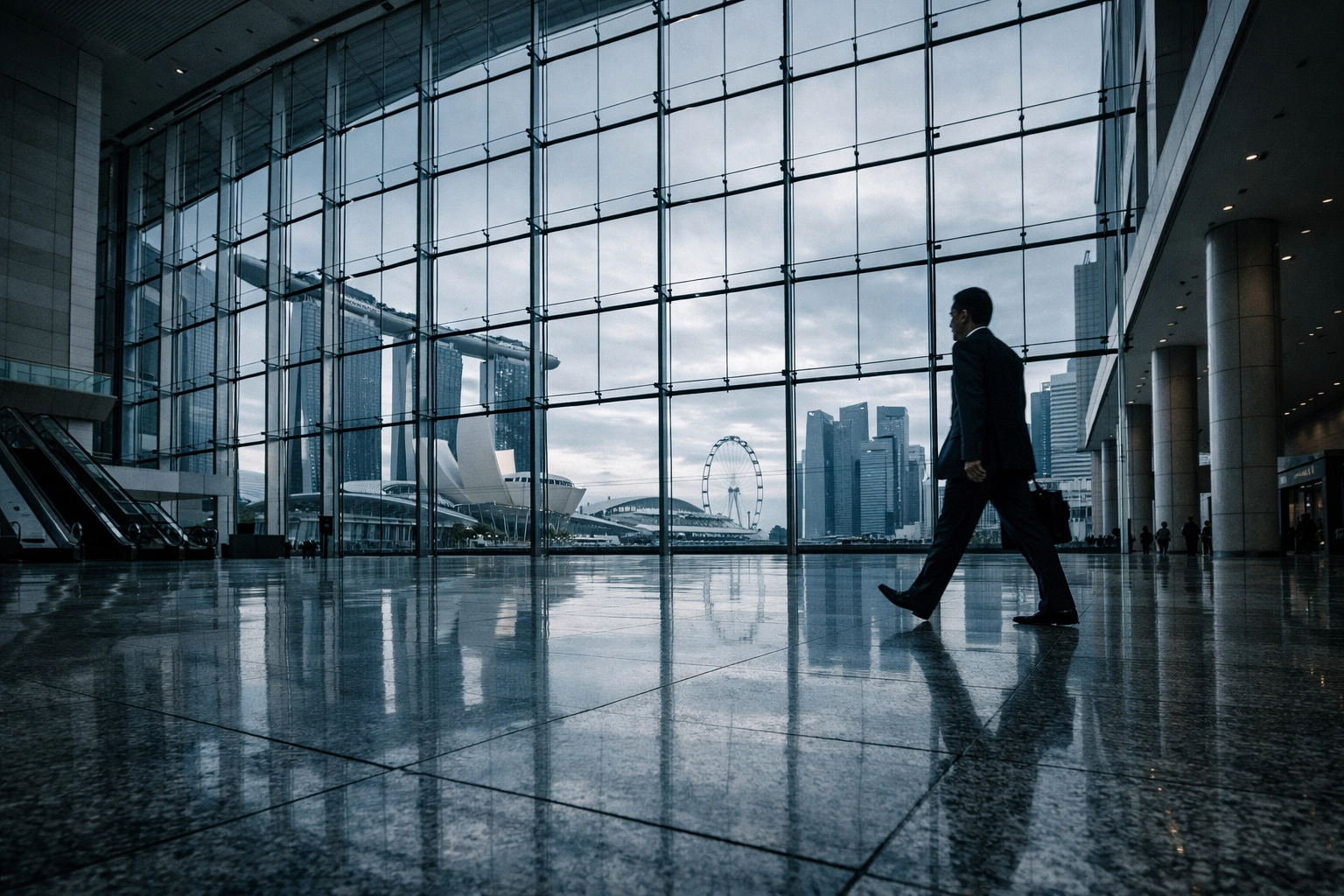
Photo: Singapore Tourism Board / Realistic view of a modern, glass-walled convention foyer overlooking the city skyline.
Infrastructure as a Strategic Mandate
The physical environment of Singapore is being restructured to accommodate this influx of elite business traffic. The strategy is built on three massive pillars of infrastructure: the expansion of Marina Bay Sands, the development of Changi Airport Terminal 5, and the study of a new downtown MICE hub.
Beginning in mid-2025, Marina Bay Sands (MBS) will undergo an expansion that includes a 15,000-seat arena and a new hotel tower. This is not merely an addition of rooms; it is the creation of a vertical ecosystem designed to host the kind of massive, multi-faceted events that define the global corporate calendar.
Simultaneously, the mid-2030s will see the arrival of Changi Airport Terminal 5. By boosting annual passenger capacity by 50 million, Singapore is ensuring that the "bridge" to the rest of the world remains wide enough to handle the surge. When we talk about Digital Bridge consulting, we often focus on the virtual, but the physical reality of Terminal 5 reminds us that global business still requires a physical touchdown point.
Perhaps most intriguing is the "New Downtown MICE Hub" currently under study. This project aims to complement existing convention spaces by creating synergies between disparate venues. It treats the city's downtown not as a collection of buildings, but as a single, integrated platform for business interaction.
Beyond the Venue: Building Civic Intelligence
A world-class convention center is useless without the human intelligence required to fill it. Under a two-year memorandum signed in 2025, the STB is partnering with the Singapore Business Federation (SBF) to equip local trade associations with the skills needed to bid for and host major international meetings.
This is a shift from passive hosting to active pursuit. By providing mentorship, consultancy, and seed funding through the "Business Events Inspired" program, Singapore is turning its local business community into a global sales force. They are not just waiting for the world to arrive; they are designing the reasons for the world to come.
This focus on capability building aligns with the bcdW Digital Bridge philosophy: where virtual expertise and local coordination converge to facilitate market entry. For companies looking to navigate the complexities of the Asian market, Singapore’s evolved MICE infrastructure provides the perfect neutral ground for strategic alignment.

Photo: Marina Bay Sands / Documentary-style shot of a high-level corporate board meeting in a wood-paneled room with floor-to-ceiling windows.
The 2030s Pipeline: A Signal of Confidence
The success of a MICE strategy is measured in the "books." Singapore’s pipeline for the next decade suggests that global organizers have already bought into the 2040 vision.
The calendar is punctuated by "first-of-its-kind" events. LSI Asia 2025 will mark the first edition of the Life Science Intelligence summit in Asia. In 2026, the Herbalife Extravaganza is expected to draw 25,000 visitors. Further out, the city has secured Sibos 2027 and the AIDA World Insurance Congress in 2031.
These are not just dates on a calendar; they are markers of confidence. In 2024, Singapore achieved its highest-ever ICCA ranking at No. 2 globally for MICE cities. The 2040 roadmap is an attempt to turn that No. 2 into a permanent, unchallenged No. 1.
The message to the Americas is clear: as the economic center of gravity continues its decades-long slide toward the Pacific, the venues of the future are being built today in the heart of Southeast Asia. For firms engaged in global mobility consulting, the expansion of Singapore’s MICE sector is the most significant signal of where the next generation of deal-making will occur.
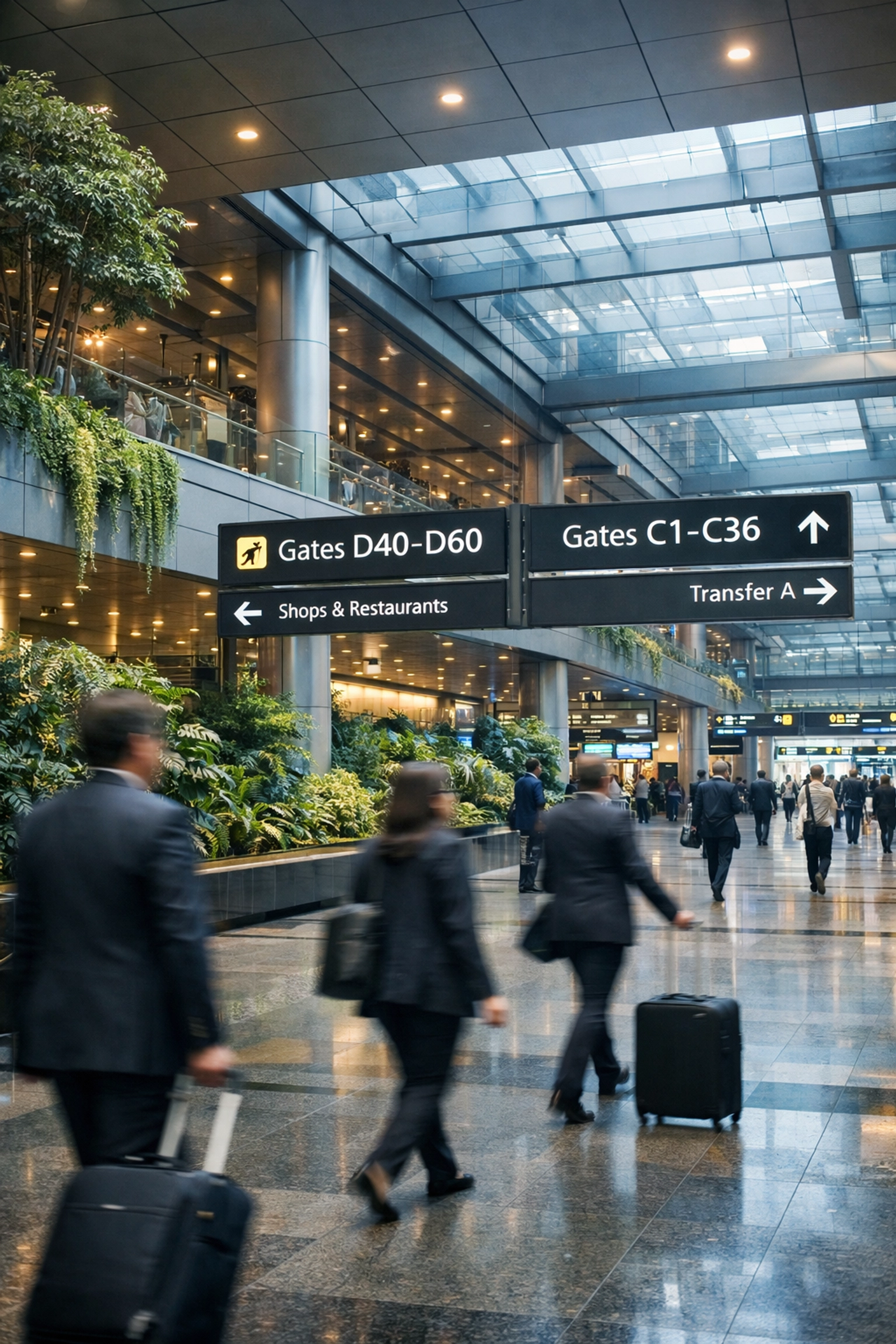
Photo: Changi Airport Group / Realistic, wide-angle shot of the modern architectural interior of an airport terminal with business travelers in transit.
The Implication: Who Moves First?
A tripling of a sector that already dominates its region is not an evolution; it is an epochal shift. Singapore is betting that even in an era of AI and virtual reality, the most consequential economic connections happen when people are in the same room.
The question for global operators is not whether Singapore will succeed. Given the track record of the "Little Red Dot," the execution is almost a foregone conclusion. The real question is how businesses in the Americas and across Asia will position themselves to leverage this new hub.
If the city is the unit of connection, as we believe at bcdW Magazine, then Singapore has just rewritten the rules for the next twenty years. The dots are being connected with unprecedented scale and precision. The question isn't whether this model works across both continents. The question is who moves first to secure their place in the new downtown of the world.
Source: Singapore Tourism Board (https://www.stb.gov.sg/)