AI Summary:
South Korean AI powerhouse Wrtn is pivoting from its dominance in East Asian markets to establish a foothold in Silicon Valley by mid-2026. By leveraging a unique "interactive storytelling" model: a hybrid of generative AI and role-playing mechanics: Wrtn aims to redefine the entertainment industry. With an aggressive trajectory toward $100 million in annual recurring revenue and a planned 2028 IPO, the company represents a significant bridge between Seoul’s narrative agility and the global scaling power of the American tech ecosystem.
The era of passive consumption is reaching its structural limit. For decades, the relationship between the creator and the audience has been a one-way street: one writes, the other reads; one films, the other watches. But in the laboratories of Seoul’s AI district, that binary is being dismantled. Wrtn, a South Korean AI startup that has quietly captured the attention of over 5 million users across Asia, is now preparing to export this disruption to the heart of the global tech industry: Silicon Valley.
Wrtn is not simply another LLM wrapper or a productivity tool. It is a narrative engine. By June 2026, the company plans to officially launch its U.S. operations, bringing a sophisticated "interactive narrative experience" to a market that is increasingly hungry for personalized, high-engagement digital content. This isn't just a product launch; it is the export of a specific cultural and technological synthesis that Seoul has perfected: the convergence of "fandom" culture, gaming mechanics, and advanced generative AI.
The Seoul-to-San Francisco Pipeline
The move to Silicon Valley is a calculated step in a broader strategy to bridge the two most influential poles of the digital economy. While Silicon Valley provides the foundational infrastructure and the venture scale, Seoul provides the "test-bed" environment: a hyper-connected, tech-literate population that demands high levels of emotional and narrative resonance from its software.
Wrtn’s platform operates as a digital dungeon master. In its Korean service, "Crack," and its Japanese counterpart, "Kyarapu," users don't just chat with an AI; they co-create worlds. The AI acts as a creative partner that responds to user choices in real-time, generating unique plot twists and character developments that ensure no two users ever experience the same story. This is the "interactive storytelling" model that Wrtn believes will resonate with American audiences who are moving away from the "infinite scroll" of social media toward more immersive, agency-driven experiences.
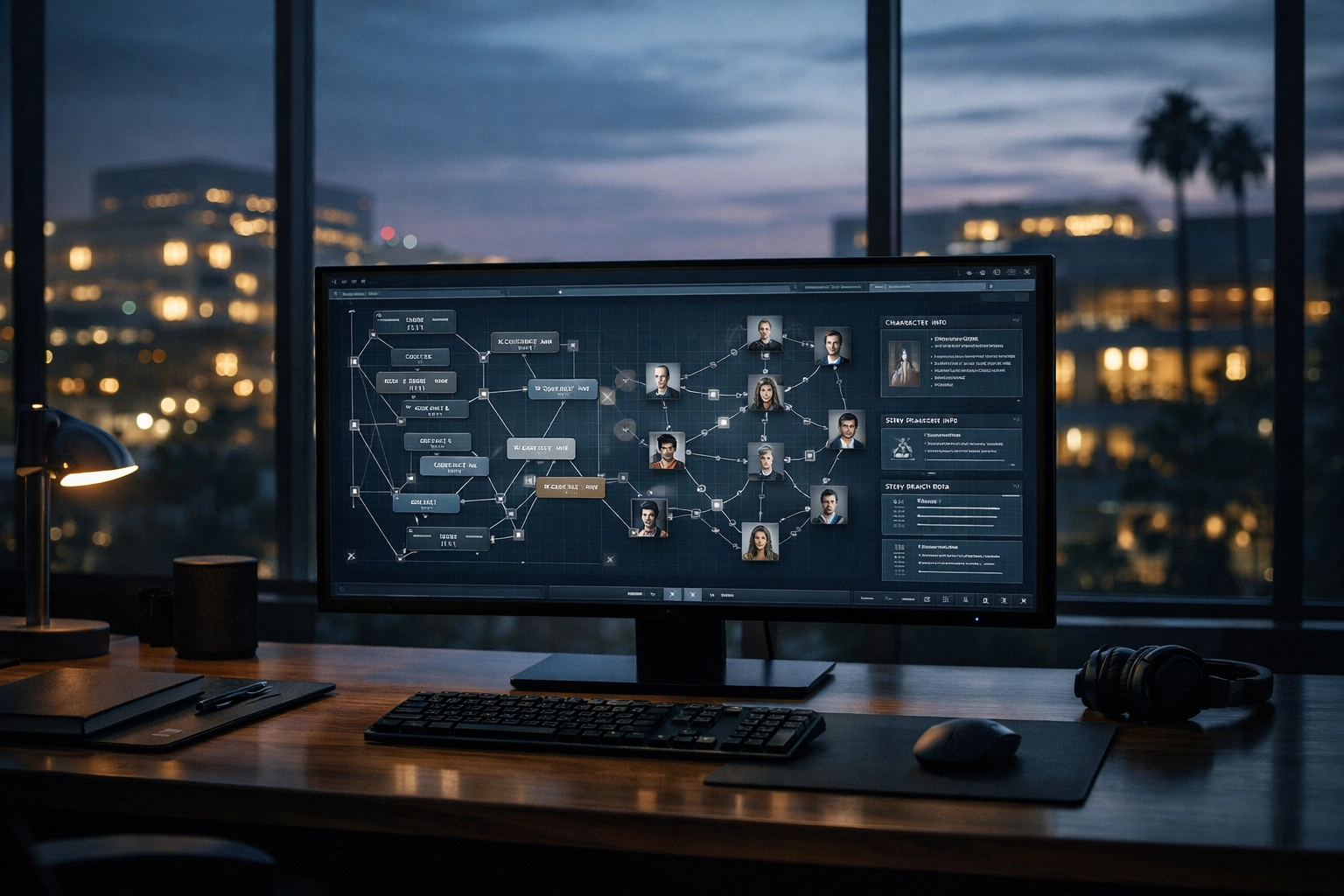
Photo: KFGO
The geographic specificity of this expansion is intentional. By establishing a presence in Silicon Valley, Wrtn is positioning itself at the intersection of AI development and Hollywood’s narrative expertise. As we have noted at bcdW Magazine, the most consequential connections are those that bridge disparate market strengths. Wrtn is the "dot" connecting the narrative precision of the K-content wave with the distribution and platform dominance of the Americas.
The Business of Narrative: $100M ARR and Beyond
Wrtn’s expansion is backed by a financial performance that demands attention. The company is on a trajectory to surpass $100 million in annual recurring revenue (ARR) by 2026. In December 2024 alone, its "Crack" service generated $1.36 million, proving that there is a massive, untapped willingness to pay for high-quality, AI-driven entertainment.
This revenue growth is underpinned by a successful Series B funding round of $73.5 million, led by Goodwater Capital, bringing their total investment to $88.5 million. This makes Wrtn the first Korean AI service platform (outside of the hardware and foundational model space) to exceed the 100 billion won cumulative investment threshold.
The goal is clear: an IPO by 2028. To reach that milestone, Wrtn must prove that its model can scale beyond the unique cultural nuances of East Asia. The U.S. market is the ultimate litmus test. If Wrtn can capture the American imagination, it transforms from a regional success story into a global infrastructure for the future of entertainment.
Redefining the Creative Economy
The entry of Wrtn into the American market signals a shift in the AI narrative itself. For the past three years, the conversation has been dominated by utility: how AI can write emails, code faster, or summarize documents. Wrtn is shifting the focus toward experience.
In the context of business consulting, this represents a new category of "Narrative Tech." It is a sector where the value is not in the efficiency of the output, but in the quality of the engagement. Wrtn’s platform suggests a future where the creative economy is not limited by a few gatekeepers in writer's rooms, but is expanded through a collaborative architecture between human intuition and machine intelligence.
This model has already found fertile ground in cities like Tokyo and Dubai, where Wrtn has established satellite offices. However, the move to the U.S. is where the "Human Mobility" of talent and ideas becomes critical. Bringing a Korean-born narrative engine to the U.S. requires more than just translation; it requires a cultural interpretation of how Americans play, dream, and create.
The bcdW Perspective: A Case Study in Cross-Continental Flow
At bcdW, we often talk about the city as the unit of connection. Wrtn’s journey is a textbook example of a "Seoul-to-Silicon Valley" corridor. Seoul provided the laboratory for rapid iteration and high-fandom engagement. Silicon Valley will provide the theatre for global competition and the regulatory/capital framework for an eventual IPO.
This move also highlights a broader trend we are tracking: the "Americas-Asia" bridge is no longer just about manufacturing or traditional trade. It is about the flow of logic and experience. Just as K-pop redefined the global music industry by prioritizing fan-to-artist engagement, Wrtn is attempting to do the same for the software industry.
The question for investors and operators in the Americas is not whether AI will change entertainment: that is already a given. The question is: who will own the narrative infrastructure? If Wrtn succeeds, the answer might come from a startup that learned how to tell stories in the high-pressure, high-innovation environment of Seoul before bringing those lessons to the world.
Looking Toward 2028
As Wrtn prepares its mid-2026 launch, the industry will be watching closely. The challenges are non-trivial: navigating the complex intellectual property landscape of the U.S. entertainment industry, adapting the AI to the linguistic and cultural subtleties of a diverse American population, and maintaining its staggering revenue growth.
But Wrtn’s history suggests a level of agility that is rare in the startup world. By focusing on "interactive storytelling": a space that lives between a book and a game: they have carved out a niche that traditional tech giants have largely overlooked.
For the strategist, Wrtn is more than a company; it is a signal. It tells us that the next wave of global platform giants will not necessarily be born in the U.S., but they will certainly have to win there to survive. The bridge between the Americas and Asia is being paved with stories: and Wrtn is currently holding the pen.
Excerpt: South Korean AI startup Wrtn is set to bring its narrative-driven 'interactive storytelling' to the U.S. market by June 2026. The company targets an IPO as early as 2028 after achieving massive revenue growth in Asia.
Category: News, Americas
City: Silicon Valley
Industry: AI, Entertainment
Source: Wrtn Press / Research via Google (https://wrtn.io)